الانتقال إلى المحتوى الرئيسي

الأبحاث والمنشورات

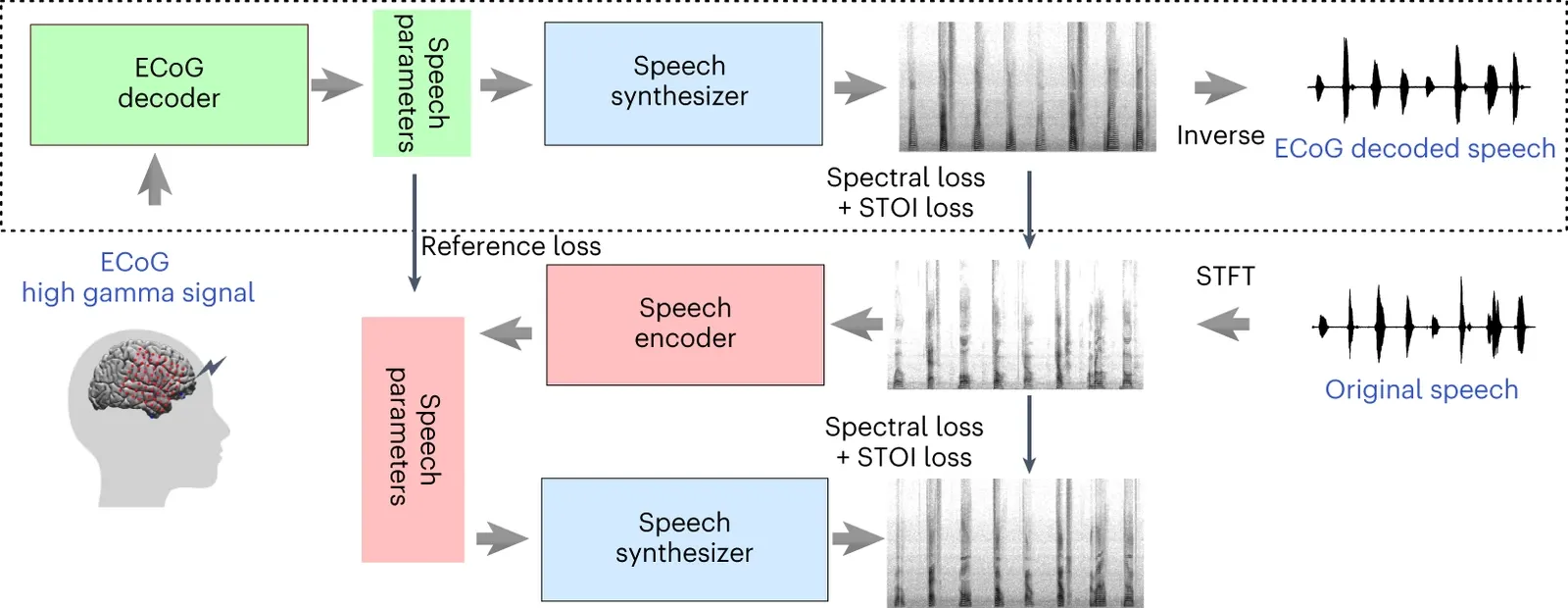
يعود الخطأ من جانب الكلام إلى وحدة فك التشفير على طول هذا المساروبالتالي فإن التدريب لا يتطلب أزواجًا من الإشارات العصبية وشروح الكلام

اسحب أفقيًا لعرض العملية الكاملة →

انقر على أي توقف لمعرفة ما تفعله هذه الخطوة

01إشارة القشريةECoG

يتم توصيل مجموعة من الأقطاب الكهربائية على سطح القشرة وتسجل نشاط غاما العالي أثناء الكلام. يختلف موقع الأقطاب الكهربائية لكل موضوع، وهي إحدى المشكلات الأولى التي يجب التعامل معها في هذا النوع من العمل.

زر الأيقونةA neural speech decoding framework leveraging deep learning and speech synthesisتمت إعادة رسم إطار عمل (Nature Machine Intelligence, 2024)، وأخذت أسماء المعلمات وقيمها من النص الأصلي.

تشن شيوبنغ

Xupeng ChenCTO

Ph.D., Electrical Engineering, NYU

NYU Tandon School of Engineering · Advisors: Yao Wang, Adeen Flinker

Google Scholar

Top 5% of all research outputs scored by Altmetric

المنشورات العلمية

خريطة الأبحاث

انقر على أي نقطة في الصورة للانتقال إلى النص المقابل

الإشارات العصبية والكلاممن إشارات القشرة إلى الكلام المنطوقتعدد الوسائط والأدلةانظر إلى الموضع الصحيح، ثم أجبالاستدلال واتباع التعليماتكثرة الاستدلال لا تعني دائما فهما أفضل للتعليمات20202021202220232024202520262026 VehAnchor: Metadata-Free Metric Scale Recovery from Vehicle Cues in Aerial Imagery2024 A neural speech decoding framework leveraging deep learning and speech synthesis2026 Why Does Grounding Hurt Medical VQA? Benchmarking, Diagnosis, and Fine-Tuning of Vision-Language Models2026 Iterative Multimodal Retrieval-Augmented Generation for Medical Question Answering2026 Comparison of sEMG Encoding Accuracy Across Speech Modes Using Articulatory and Phoneme Features2025 VoxelFormer: Parameter-Efficient Multi-Subject Visual Decoding from fMRI2025 Machine Learning-Based Prediction of Speech Arrest During Direct Cortical Stimulation Mapping2025 When Thinking Fails: The Pitfalls of Reasoning for Instruction-Following in LLMs2025 Transformer-based neural speech decoding from surface and depth electrode signals2024 R-LLaVA: Improving Med-VQA Understanding through Visual Region of Interest2024 A corollary discharge circuit in human speech2023 Distributed feedforward and feedback cortical processing supports human speech production2020 Stimulus Speech Decoding From Human Cortex with Generative Adversarial Network Transfer Learning

اسحب أفقيًا لعرض الخريطة الكاملة →

2026تعدد الوسائط والأدلة

VehAnchor: Metadata-Free Metric Scale Recovery from Vehicle Cues in Aerial Imagery

IEEE/RSJ International Conference on Intelligent Robots and Systems (IROS) · IROS 2026 · Accepted

  • 期刊与会议 6 篇
  • 7 مطبوعات أولية
  • الحائز على جائزة أو رفيعة المستوى

13 篇 · 2020 到 2026 · 三条线

  1. 2026

    VehAnchor: Metadata-Free Metric Scale Recovery from Vehicle Cues in Aerial Imagery

    Yifei Chen, Chenqian Le, Jiayi Cheng, Xupeng Chen

    المؤلف الأول: Yifei Chen (مهندس خوارزميات) · المؤلف المراسل: Xupeng Chen · انتماء كليهما: Dimension Gate

    IEEE/RSJ International Conference on Intelligent Robots and Systems (IROS)IROS 2026 · AcceptedarXiv:2603.04277

    A deterministic geometric perception skill for embodied agents: detect common vehicles in metadata-free aerial imagery, recover ground sample distance, and return a confidence score before metric decisions are made. Yifei Chen is first author; Xupeng Chen is corresponding author. Both are affiliated with Dimension Gate.

  2. 2024Top 5% of all research outputs (Altmetric)

    A neural speech decoding framework leveraging deep learning and speech synthesis

    Xupeng Chen, Ran Wang, Amirhossein Khalilian-Gourtani, Leyao Yu, Patricia Dugan, Daniel Friedman, Werner Doyle, Orrin Devinsky, Yao Wang, Adeen Flinker

    Nature Machine IntelligenceVol. 6, No. 4, pp. 467–480doi:10.1038/s42256-024-00824-8

    An ECoG decoder that translates cortical signals into interpretable speech parameters, paired with a differentiable speech synthesizer. Reproducible across 48 participants; the 3D ResNet decoder reaches PCC 0.804 against the original spectrogram, and stays high under causal-only operation as required for real-time neural prostheses.

    يقوم جهاز فك ترميز ECoG بإخراج معلمات الكلام، والتي يتم استعادتها إلى الطيف بواسطة مركب الكلام القابل للتمييز، ويتم مقارنتها مع طيف الكلام الأصلي ثم يتم نشرها بشكل عكسي.

    اسحب أفقيًا لعرض الصورة كاملة →

    Fig. 1الحلقة المغلقة للإطار بأكمله: يقوم جهاز فك ترميز ECoG بترجمة إشارة جاما القشرية العالية إلى مجموعة من معلمات الكلام القابلة للتفسير، ويقوم مُركِّب الكلام القابل للتمييز باستعادة هذه المجموعة من المعلمات إلى نطاق. إن جهاز النطق قابل للتمييز، لذا يمكن نشر الخسارة في جانب الكلام وصولاً إلى وحدة فك التشفير - لا يتطلب التدريب محاذاة صارمة لتعليقات "الإشارة العصبية للكلام" المقترنة.الصورة الأصلية ↗·CC BY 4.0
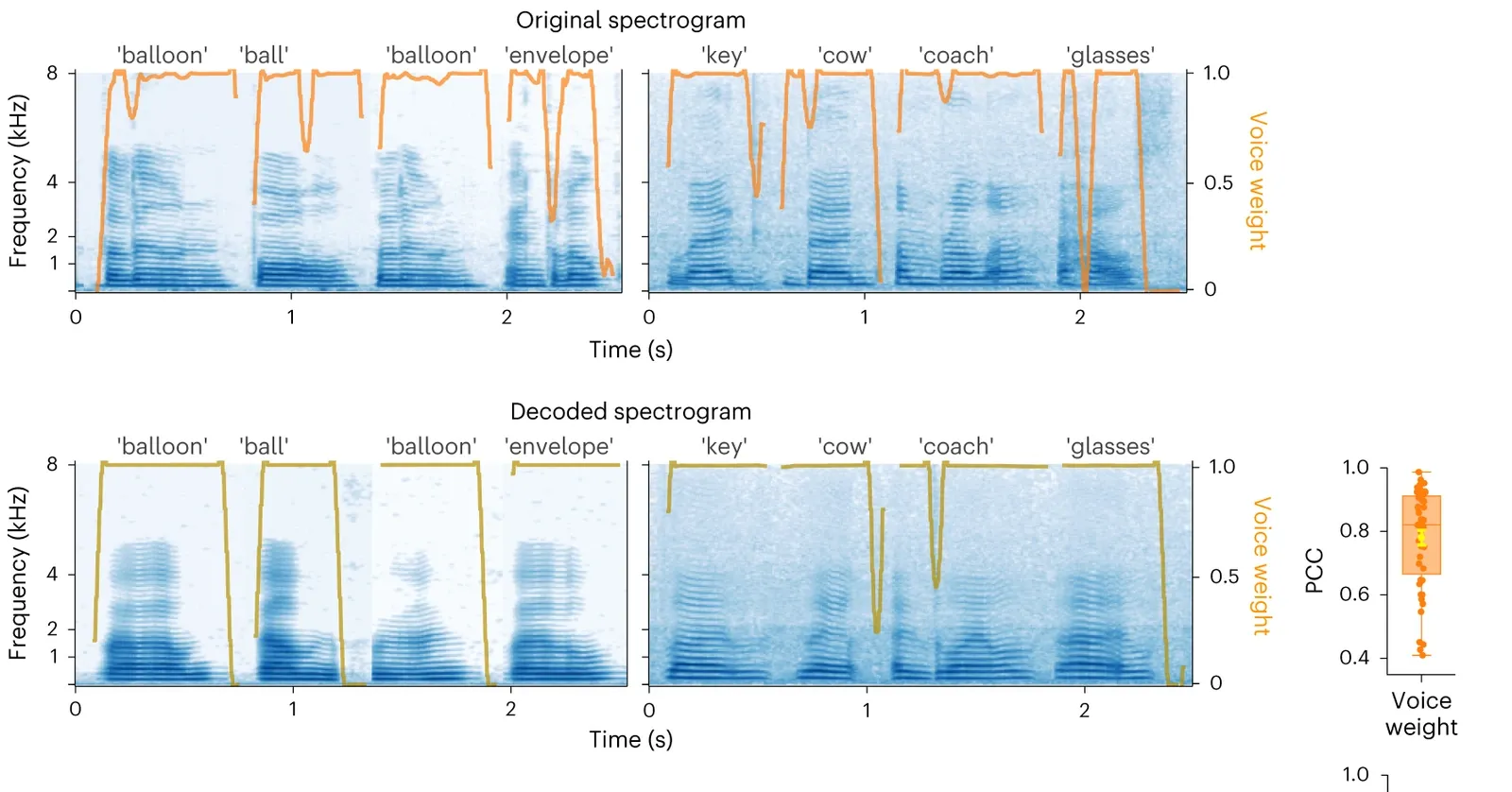
    تتم مقارنة طيف الكلام الأصلي والطيف الذي تم فك تشفيره كلمة بكلمة، وتتوافق الهياكل التوافقية للكلمات الإنجليزية الثماني مع كلمة واحدة.

    اسحب أفقيًا لعرض الصورة كاملة →

    Fig. 2c–dالصف العلوي هو طيف الكلمات الثماني التي يتحدث بها الشخص بالفعل، والصف السفلي هو الطيف الذي تم فك شفرته من الإشارة القشرية وحدها. البنية التوافقية، ولحظات البداية والنهاية، والتغيرات في الوضوح والتعكر كلها متسقة - في 48 موضوعًا، وصل معامل الارتباط بين وحدة فك ترميز ResNet ثلاثية الأبعاد والطيف الأصلي إلى 0.804.الصورة الأصلية ↗·CC BY 4.0
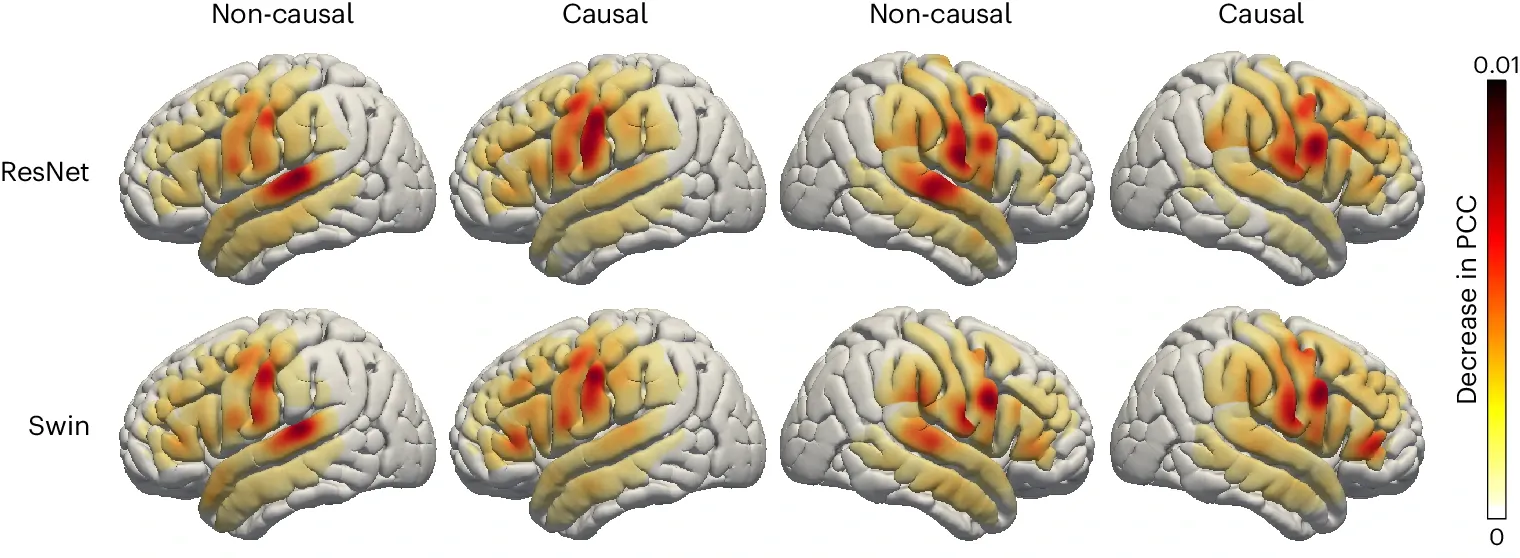
    تُظهر الخريطة الحرارية للقشرة الدماغية اليسرى الانخفاض في معامل ارتباط فك التشفير بعد إخفاء كل منطقة. وتتركز المناطق الساخنة في القشرة الحسية الحركية والتلفيف الصدغي العلوي.

    اسحب أفقيًا لعرض الصورة كاملة →

    Fig. 4إن تغطية منطقة معينة من القشرة ستؤدي إلى تقليل جودة فك التشفير - فكلما زاد فقدانها، أصبح اللون أغمق. تركزت المناطق الساخنة في القشرة الحسية الحركية والتلفيف الصدغي العلوي، وتم تكاثرها بشكل ثابت في كل من أجهزة فك التشفير، والإعدادات السببية وغير السببية. لا يعتمد هذا الاستنتاج على اختيار النموذج، مما يشير إلى أن النموذج تعلم شيئًا منطقيًا من الناحية الفسيولوجية.الصورة الأصلية ↗·CC BY 4.0
  3. 2026

    Why Does Grounding Hurt Medical VQA? Benchmarking, Diagnosis, and Fine-Tuning of Vision-Language Models

    Xupeng Chen, Binbin Shi, Chenqian Le, Qifu Yin, Lang Lin, Haowei Ni, Ran Gong, Panfeng Li

    arXiv preprintarXiv:2604.27720

    Asks why telling a vision-language model where to look often makes its answer worse. Benchmarks frontier VLMs on medical grounding, separates the two failure modes — the box lands in the wrong place, or the box is right but cropping to it throws away the context the answer needed — and shows what fine-tuning does and does not fix.

  4. 2026

    Iterative Multimodal Retrieval-Augmented Generation for Medical Question Answering

    Xupeng Chen, Binbin Shi, Chenqian Le, Jiaqi Zhang, Kewen Wang, Ran Gong, Jinhan Zhang, Chihang Wang

    arXiv preprintarXiv:2604.27724

    MedVRAG retrieves over ~350K page images from the literature rather than over plain text, then decides for itself whether the evidence it pulled is enough — and goes back for more if it is not. Most questions settle in one round; the hard ones are exactly the ones that need a second and third.

  5. 2026

    Comparison of sEMG Encoding Accuracy Across Speech Modes Using Articulatory and Phoneme Features

    Chenqian Le, Ruisi Li, Beatrice Fumagalli, Yasamin Esmaeili, Xupeng Chen, Amirhossein Khalilian-Gourtani, Tianyu He, Adeen Flinker, Yao Wang

    arXiv preprintarXiv:2604.18920

    Surface EMG from the face and neck, compared across spoken, mimed and silently imagined speech. Asks how much of the articulatory signal survives when no sound is produced — the question any silent-speech interface has to answer before it can work.

  6. 2025

    VoxelFormer: Parameter-Efficient Multi-Subject Visual Decoding from fMRI

    Chenqian Le, Yilin Zhao, Nikasadat Emami, Kushagra Yadav, Xujin "Chris" Liu, Xupeng Chen, Yao Wang

    arXiv preprintarXiv:2509.09015

    Decodes what a person is looking at from fMRI, with one model shared across subjects instead of one model per brain. A token-merging encoder maps voxels into a CLIP embedding space, so adding a new subject costs a fraction of the parameters a per-subject model would.

  7. 2025

    Machine Learning-Based Prediction of Speech Arrest During Direct Cortical Stimulation Mapping

    Nikasadat Emami, Amirhossein Khalilian-Gourtani, Jianghao Qian, Antoine Ratouchniak, Xupeng Chen, Yao Wang, Adeen Flinker

    arXiv preprintarXiv:2509.08703

    Predicts which cortical sites will arrest speech when stimulated — the mapping a surgeon currently has to establish by stimulating the awake patient site by site. Same signal, read ahead of time instead of found the hard way.

  8. 2025

    When Thinking Fails: The Pitfalls of Reasoning for Instruction-Following in LLMs

    Xiaomin Li, Zhou Yu, Zhiwei Zhang, Xupeng Chen, Ziji Zhang, Yingying Zhuang, Narayanan Sadagopan, Anurag Beniwal

    arXiv preprintarXiv:2505.11423

    Chain-of-thought prompting is supposed to make models better. On instruction following it frequently makes them worse: the model reasons its way past a constraint it would have obeyed if asked directly. Measures where the trade-off bites and what mitigates it.

  9. 2025

    Transformer-based neural speech decoding from surface and depth electrode signals

    Junbo Chen, Xupeng Chen, Ran Wang, Chenqian Le, Amirhossein Khalilian-Gourtani, Erika Jensen, Patricia Dugan, Werner Doyle, Orrin Devinsky, Daniel Friedman, Adeen Flinker, Yao Wang

    Journal of Neural EngineeringVol. 22, No. 1, 016017doi:10.1088/1741-2552/adab21

    SwinTW, a transformer that works with arbitrarily positioned electrodes by using their 3D cortical coordinates rather than a 2D grid. Subject-specific models on low-density 8×8 ECoG reach PCC 0.817 across 43 participants, freeing future speech prostheses from grid-only electrode layouts.

  10. 2024

    R-LLaVA: Improving Med-VQA Understanding through Visual Region of Interest

    Xupeng Chen, Zhixin Lai, Kangrui Ruan, Shichu Chen, Jiaxiang Liu, Zuozhu Liu

    arXiv preprintarXiv:2410.20327

    Injects the region a clinician would actually look at straight into the visual token stream, so the model reasons over the lesion instead of over the whole slide. The line of work that the 2026 grounding benchmark above grew out of, and argued with.

  11. 2024

    A corollary discharge circuit in human speech

    Amirhossein Khalilian-Gourtani, Ran Wang, Xupeng Chen, Leyao Yu, Patricia Dugan, Daniel Friedman, Werner Doyle, Orrin Devinsky, Yao Wang, Adeen Flinker

    Proceedings of the National Academy of Sciences (PNAS)Vol. 121, No. 50, e2404121121doi:10.1073/pnas.2404121121

    Identifies a reproducible corollary discharge source in ventral speech motor cortex that fires before articulation and predicts how strongly auditory cortex is suppressed during speech — how the brain tells its own voice apart from the world.

  12. 2023

    Distributed feedforward and feedback cortical processing supports human speech production

    Ran Wang, Xupeng Chen, Amirhossein Khalilian-Gourtani, Leyao Yu, Patricia Dugan, Daniel Friedman, Werner Doyle, Orrin Devinsky, Yao Wang, Adeen Flinker

    Proceedings of the National Academy of Sciences (PNAS)Vol. 120, No. 42, e2300255120doi:10.1073/pnas.2300255120

    Uses causal, anticausal and noncausal convolutional architectures to disentangle motor control from sensory processing during speech, revealing a mixed feedforward/feedback recruitment across perisylvian cortex.

  13. 2020Best Paper Award Finalist

    Stimulus Speech Decoding From Human Cortex with Generative Adversarial Network Transfer Learning

    Ran Wang, Xupeng Chen, Amirhossein Khalilian-Gourtani, Zhaoxi Chen, Leyao Yu, Adeen Flinker, Yao Wang

    IEEE International Symposium on Biomedical Imaging (ISBI)

    Applies GAN transfer learning to decode heard speech from cortical recordings, addressing the scarcity of paired neural-speech data.

الصور الثلاث الأصلية الموجودة على الصفحة مأخوذة من الأوراق المذكورة أعلاه. جميعها مفتوحة الوصول ومرخصة بموجب CC BY 4.0. يمكن العثور على رابط التوقيع والترخيص في وسيلة إيضاح كل شخصية. يتم تغيير حجم لوحة الصورة وفقًا لعرض التخطيط. بالنسبة لبعض الصور، يتم التقاط اللوحات الفرعية فقط، ولا يتغير لون البكسل. حقوق الطبع والنشر للأوراق المتبقية مملوكة للناشر ولا يجوز إعادة إنتاجها دون إذن.

من الأوراق إلى المنتجات

البحث الأكاديمي والتنفيذ

01

اترك الكلمات التي لم تقال

الأبحاث

ركز CTO والعالم الرئيسي Xupeng Chen خلال الدكتوراه على فك ترميز الكلام من الإشارات العصبية، مع مخرجات كلامية قابلة للتفسير ومستقرة التكرار. ونواصل الاتجاه نفسه: استعادة الأفكار التي تتشكل قبل أن ينطق الإنسان. هذا جزء من الحمض التقني لبوابة الأبعاد.

تقع على المنتج

ومن هنا تأتي عبارة "ثمانية بتات في الثانية". لا يمكن لمنتجات اليوم أن تصل إلى القشرة، لكن الاتجاه هو نفسه: يحتفظ MinuteX أولاً بالجزء الذي يقال بالكامل، ثم يدفعه إلى المكان الغامض، ونصف القول، ولم يكن لديه الوقت لقوله في ذلك الوقت.

الورق المقابلNature Machine Intelligence 2024Journal of Neural Engineering 2025PNAS 2024arXiv:2604.18920arXiv:2509.08703

02

اجعل آذان وعين النموذج الكبير واضحة

الأبحاث

في العامين الماضيين، كان هذا الخط يقوم بعمل طرق متعددة: لمجرد أن النموذج أجاب على السؤال بشكل صحيح، فهذا لا يعني أنه نظر إلى المكان الصحيح. قمنا بفصل وتقييم "أين ننظر" و"ما يجب الإجابة عليه" بشكل منفصل، ووجدنا أن النماذج المتطورة غالبًا ما تجيب على أسئلة لائقة على الرغم من أن جميع المربعات كانت خاطئة في الصور الطبية؛ تم تغيير البحث أيضًا من استرجاع النص العادي إلى استرجاع صور الصفحة، بحيث يمكن الإشارة إلى الأدلة.

تقع على المنتج

أي استنتاج، طالما أنه يُقرأ من الصورة، لا يمكنه تجنب نفس المشكلة: يجب أن يكون قادرًا على الإشارة إلى الجزء الذي نظر إليه المرء. هذا هو أصل شيء تتبع الأدلة في المنتج. نحن لا نسمح بظهور الاستنتاجات التي لا يمكن تتبعها على الواجهة.

الورق المقابلarXiv:2604.27720arXiv:2604.27724arXiv:2410.20327arXiv:2509.09015

03

القدرة على التفكير لا تعني القدرة على فهم الكلمات

الأبحاث

نود أن نجعل النموذج يفكر مرة أخرى قبل الإجابة، ولكن هذا الوضع سيجعل متابعة التعليمات أسوأ. تكشف هذه المقالة أنه إذا كان وقت الاستدلال للنموذج طويلاً جدًا، فسوف يقلب القيود الأصلية، وكيفية تخفيف العبء المعرفي الناجم عن الاستدلال الزائد للنموذج.

تقع على المنتج

في نظام متعدد الوكلاء، قد يتصرف وكيل واحد من تلقاء نفسه ويمرر الخطأ عبر السلسلة. لذلك جعلنا التصحيح فعلا صريحا: CONFIRM وCORRECT وDISMISS وUPSERT. هذه هي الطريقة التي تتحول بها الأبحاث المتقدمة إلى ممارسة منتجية.

الورق المقابلarXiv:2505.11423

مسار بحثي مستقل

الذكاء الحضري والحوسبة المكانية الزمنية

Guanjie Zheng

Guanjie Zhengأستاذ مشارك ضمن مسار التثبيت

His research focuses on AI methods that understand, represent, and interact with complex urban and transportation systems.

John Hopcroft Center for Computer Science · Shanghai Jiao Tong University

Ph.D., Information Sciences and Technology, Penn State, 2020 · Advisor: Zhenhui (Jessie) Li

B.E., Electrical Engineering, Shanghai Jiao Tong University, 2015

التكريمات الأكاديمية

  • ECML-PKDD 2020 Best Applied Data Science Paper Award
  • Baidu AI Chinese Rising Stars Top 100
  • ACM SIGSPATIAL China Rising Star in Spatial Intelligence

مجالات البحث

Spatial Reasoning on Multimodal Models in Urban Environments

Integrating maps, trajectories, imagery, and text to reason about urban dynamics and transportation systems.

Urban Foundation Representation Models

Learning scalable, transferable representations for prediction, simulation, and generalization across cities.

Reliable and Trustworthy Embodied Urban AI

Building reliable, safe, and transparent agents for complex real-world urban systems.

القائمة الكاملة للمنشورات

45 بحثا · 2017–2026 · # المؤلف المراسل · * مساهمة متساوية

20264 أبحاث
  1. 01

    TRACK: Temporal Decoupled Kriging for Inductive Spatio-temporal Graph

    Jianping Zhou, Weida Wang, Bin Lu, Guanjie Zheng, Lei Bai, Xinbing Wang, Chenghu Zhou

    IEEE Transactions on Knowledge and Data Engineering

  2. 02

    OSM+: Billion-Level OpenStreetMap Data Processing System for City-wide Experiments

    Guanjie Zheng, Ziyang Su, Yiheng Wang, Yuhang Luo, Hongwei Zhang, Xuanhe Zhou, Linghe Kong, Fan Wu, Wen Ling

    International Conference on Machine Learning (ICML)

  3. 03

    GeoFlow: Geo-Aware Modeling of Inter-Area Relationships in OD Flow Prediction and Generation

    Zherui Huang, Guanjie Zheng, Hao Xue, Linghe Kong

    International Conference on Machine Learning (ICML)Spotlight

  4. 04

    Planning Under Observation Mismatch for Traffic Signal Control via Adaptive Modular World Models

    Zherui Huang, Yicheng Liu, Chumeng Liang, Guanjie Zheng

    International Conference on Automated Planning and Scheduling (ICAPS)

20255 أبحاث
  1. 01

    MetaCity: Data-driven sustainable development of complex cities

    Yunke Zhang, Yuming Lin, Guanjie Zheng, Yu Liu, Nicholas Sukiennik, Fengli Xu, Yongjun Xu, Feng Lu, Qi Wang, Yuan Lai, Li Tian, Nan Li, Dongping Fang, Fei Wang, Tao Zhou, Yong Li, Yu Zheng, Zhiqiang Wu, Huadong Guo

    The Innovation

  2. 02

    Big-data empowered traffic signal control could reduce urban carbon emission

    Kan Wu, Jianrong Ding, Jingli Lin, Guanjie Zheng, Yi Sun, Jie Fang, Tu Xu, Yongdong Zhu, Baojing Gu

    Nature Communications

  3. 03

    Safety-critical traffic simulation with adversarial transfer of driving intentions

    Zherui Huang, Xing Gao, Guanjie Zheng#, Licheng Wen, Xuemeng Yang, Xiao Sun

    IEEE International Conference on Robotics and Automation (ICRA)

  4. 04

    MagiNet: Mask-Aware Graph Imputation Network for Incomplete Traffic Data

    Jianping Zhou, Bin Lu, Zhanyu Liu, Siyu Pan, Xuejun Feng, Hua Wei, Guanjie Zheng#, Xinbing Wang, Chenghu Zhou

    ACM Transactions on Knowledge Discovery from Data

  5. 05

    Multi-scale Traffic Pattern Bank for Cross-city Few-shot Traffic Forecasting

    Zhanyu Liu, Guanjie Zheng#, Yanwei Yu

    ACM Transactions on Knowledge Discovery from Data

20246 أبحاث
  1. 01

    Graph Data Condensation via Self-Expressive Graph Structure Reconstruction

    Zhanyu Liu, Chaolv Zeng, Guanjie Zheng#

    ACM SIGKDD Conference on Knowledge Discovery and Data Mining (KDD)

  2. 02

    Dataset Condensation for Time Series Classification via Dual Domain Matching

    Zhanyu Liu, Ke Hao, Guanjie Zheng#, Yanwei Yu

    ACM SIGKDD Conference on Knowledge Discovery and Data Mining (KDD)

  3. 03

    Precise Control Balances Epidemic Mitigation and Economic Growth

    Yiheng Wang, Guanjie Zheng#, Hexi Jin, Yi Sun, Kan Wu, Jie Fang

    npj Urban Sustainability

  4. 04

    Frequency Enhanced Pre-training for Cross-city Few-shot Traffic Forecasting

    Zhanyu Liu, Jianrong Ding, Guanjie Zheng#

    European Conference on Machine Learning and Principles and Practice of Knowledge Discovery in Databases (ECML PKDD)

  5. 05

    Towards Controlled Table-to-Text Generation with Scientific Reasoning

    Zhixin Guo, Jianping Zhou, Jiexing Qi, Mingxuan Yan, Ziwei He, Guanjie Zheng#, Zhouhan Lin, Xinbing Wang, Chenghu Zhou

    IEEE International Conference on Acoustics, Speech and Signal Processing (ICASSP)

  6. 06

    GeoKnowledgeFusion: A Platform for Multimodal Data Compilation from Geoscience Literature

    Zhixin Guo, Chaoyang Wang, Jianping Zhou, Guanjie Zheng#, Xinbing Wang, Chenghu Zhou

    Remote Sensing

20235 أبحاث
  1. 01

    CBLab: Supporting the Training of Large-scale Traffic Control Policies with Scalable Traffic Simulation

    Chumeng Liang, Zherui Huang, Yicheng Liu, Zhanyu Liu, Guanjie Zheng#, Hanyuan Shi, Kan Wu, Yuhao Du, Fuliang Li, Zhenhui Li

    ACM SIGKDD Conference on Knowledge Discovery and Data Mining (KDD)

  2. 02

    Cross-city Few-Shot Traffic Forecasting via Traffic Pattern Bank

    Zhanyu Liu, Guanjie Zheng#, Yanwei Yu

    ACM International Conference on Information and Knowledge Management (CIKM)

  3. 03

    FDTI: Fine-Grained Deep Traffic Inference with Roadnet-Enriched Graph

    Zhanyu Liu, Chumeng Liang, Guanjie Zheng#, Hua Wei

    European Conference on Machine Learning and Principles and Practice of Knowledge Discovery in Databases (ECML PKDD)

  4. 04

    Uncertainty-aware Traffic Prediction under Missing Data

    Hao Mei, Junxian Li, Zhiming Liang, Guanjie Zheng, Bin Shi, Hua Wei

    IEEE International Conference on Data Mining (ICDM)

  5. 05

    Multiplex Heterogeneous Graph Neural Network with Behavior Pattern Modeling

    Chaofan Fu, Guanjie Zheng, Chao Huang, Yanwei Yu, Junyu Dong

    ACM SIGKDD Conference on Knowledge Discovery and Data Mining (KDD)

20223 أبحاث
  1. 01

    CTRL: Cooperative Traffic Tolling via Reinforcement Learning

    Yiheng Wang, Hexi Jin, Guanjie Zheng#

    ACM International Conference on Information and Knowledge Management (CIKM)

  2. 02

    MedAttacker: Exploring Black-Box Adversarial Attacks on Risk Prediction Models in Healthcare

    Muchao Ye, Junyu Luo, Guanjie Zheng, Cao Xiao, Houping Xiao, Ting Wang, Fenglong Ma

    IEEE International Conference on Bioinformatics and Biomedicine (BIBM)

  3. 03

    CTRL: Using a Neural Network-Physics-Based Hybrid Model to Predict Soil Reaction Fronts

    Tao Wen, Chacha Chen, Guanjie Zheng, Joel Bandstra, Susan L. Brantley

    Computers & Geosciences

20216 أبحاث
  1. 01

    Knowledge-based Residual Learning

    Guanjie Zheng, Chang Liu, Hua Wei, Porter Jenkins, Chacha Chen, Tao Wen, Zhenhui Li

    International Joint Conference on Artificial Intelligence (IJCAI)

  2. 02

    Objective-aware Traffic Simulation via Inverse Reinforcement Learning

    Guanjie Zheng, Hanyang Liu, Kai Xu, Zhenhui Li

    International Joint Conference on Artificial Intelligence (IJCAI)

  3. 03

    Learning to Simulate on Sparse Trajectory Data

    Hua Wei, Chacha Chen, Chang Liu, Guanjie Zheng, Zhenhui Li

    Machine Learning and Knowledge Discovery in Databases: Applied Data Science Track (ECML PKDD)

  4. 04

    Rebuilding City-Wide Traffic Origin-Destination from Road Speed Data

    Guanjie Zheng*, Chang Liu*, Hua Wei, Chacha Chen, Zhenhui Li

    IEEE International Conference on Data Engineering (ICDE)

  5. 05

    Recent Advances in Reinforcement Learning for Traffic Signal Control: A Survey of Models and Evaluation

    Hua Wei, Guanjie Zheng, Vikash Gayah, Zhenhui Li

    ACM SIGKDD Explorations Newsletter

  6. 06

    Detecting Anomalous Methane in Groundwater within Hydrocarbon Production Areas across the United States

    Tao Wen, Mengqi Liu, Josh Woda, Guanjie Zheng, Susan L. Brantley

    Water Research

20205 أبحاث
  1. 01

    GeneraLight: Improving Environment Generalization of Traffic Signal Control via Meta Reinforcement Learning

    Huichu Zhang, Chang Liu, Weinan Zhang, Guanjie Zheng, Yong Yu

    ACM International Conference on Information and Knowledge Management (CIKM)

  2. 02

    Learning to Simulate on Sparse Trajectory Data

    Hua Wei, Chacha Chen, Chang Liu, Guanjie Zheng, Zhenhui Li

    European Conference on Machine Learning and Principles and Practice of Knowledge Discovery in Databases (ECML PKDD)Best Applied Data Science Paper

  3. 03

    Toward A Thousand Lights: Decentralized Deep Reinforcement Learning for Large-Scale Traffic Signal Control

    Chacha Chen, Hua Wei, Nan Xu, Guanjie Zheng, Ming Yang, Yuanhao Xiong, Kai Xu, Zhenhui Li

    AAAI Conference on Artificial Intelligence (AAAI)

  4. 04

    MetaLight: Value-based Meta-Reinforcement Learning for Traffic Signal Control

    Xinshi Zang, Huaxiu Yao, Guanjie Zheng, Nan Xu, Kai Xu, Zhenhui Li

    AAAI Conference on Artificial Intelligence (AAAI)

  5. 05

    Learning to Simulate Vehicle Trajectories from Demonstrations

    Guanjie Zheng*, Hanyang Liu*, Kai Xu, Zhenhui Li

    IEEE International Conference on Data Engineering (ICDE), short paper

20196 أبحاث
  1. 01

    Learning Phase Competition for Traffic Signal Control

    Guanjie Zheng, Yuanhao Xiong, Xinshi Zang, Jie Feng, Hua Wei, Huichu Zhang, Yong Li, Kai Xu, Zhenhui Li

    ACM International Conference on Information and Knowledge Management (CIKM)

  2. 02

    CoLight: Learning Network-level Cooperation for Traffic Signal Control

    Hua Wei, Nan Xu, Huichu Zhang, Guanjie Zheng, Xinshi Zang, Chacha Chen, Weinan Zhang, Yanmin Zhu, Kai Xu, Zhenhui Li

    ACM International Conference on Information and Knowledge Management (CIKM)

  3. 03

    Learning Traffic Signal Control from Demonstrations

    Yuanhao Xiong, Guanjie Zheng, Kai Xu, Zhenhui Li

    ACM International Conference on Information and Knowledge Management (CIKM)

  4. 04

    PressLight: Learning Max Pressure Control to Coordinate Traffic Signals in Arterial Networks

    Hua Wei, Chacha Chen, Guanjie Zheng, Kan Wu, Vikash V. Gayah, Kai Xu, Zhenhui Li

    ACM SIGKDD Conference on Knowledge Discovery and Data Mining (KDD)

  5. 05

    Targeted Transfer Reinforcement Learning for Traffic Signal Control in a Hierarchical Framework

    Nan Xu, Guanjie Zheng, Kai Xu, Yanmin Zhu, Zhenhui Li

    Pacific-Asia Conference on Knowledge Discovery and Data Mining (PAKDD)

  6. 06

    Revisiting Spatial-Temporal Similarity: A Deep Learning Framework for Traffic Prediction

    Huaxiu Yao*, Xianfeng Tang*, Hua Wei, Guanjie Zheng, Zhenhui Li

    AAAI Conference on Artificial Intelligence (AAAI)

20182 أبحاث
  1. 01

    IntelliLight: A Reinforcement Learning Approach for Intelligent Traffic Light Control

    Hua Wei*, Guanjie Zheng*, Huaxiu Yao, Zhenhui Li

    ACM SIGKDD Conference on Knowledge Discovery and Data Mining (KDD)

  2. 02

    DRN: A Deep Reinforcement Learning Framework for News Recommendation

    Guanjie Zheng, Fuzheng Zhang, Zihan Zheng, Yang Xiang, Nicholas Jing Yuan, Xing Xie, Zhenhui Li

    The Web Conference (WWW)

20173 أبحاث
  1. 01

    Contextual Spatial Outlier Detection with Metric Learning

    Guanjie Zheng, Susan L. Brantley, Thomas Lauvaux, Zhenhui Li

    ACM SIGKDD Conference on Knowledge Discovery and Data Mining (KDD)

  2. 02

    Assessing Environmental Impacts of Shale-gas Development in an Area of Hydraulic Fracturing

    Guanjie Zheng, Fei Wu, Matthew Gonzales, Susan L. Brantley, Thomas Lauvaux, Zhenhui Li

    KDD Workshop on Data Science for Intelligent Food, Energy, and Water (DSIFER)

  3. 03

    Discovery of Causal Time Intervals

    Zhenhui Li, Guanjie Zheng, Amal Agarwal, Lingzhou Xue, Thomas Lauvaux

    SIAM International Conference on Data Mining (SDM)

تتبع القائمة الكاملة وعلامات المؤلفين الصفحة الرسمية في جامعة شانغهاي جياو تونغ.