

A paper first-authored by Dimension Gate algorithm engineer Yifei Chen has been accepted at IROS 2026, a premier robotics conference. Xupeng Chen is the corresponding author; both are affiliated with Dimension Gate.
The paper is titled VehAnchor: Metadata-Free Metric Scale Recovery from Vehicle Cues in Aerial Imagery, by Yifei Chen, Chenqian Le, Jiayi Cheng, and Xupeng Chen, in that order. It studies how aerial robots can recover physical scale from imagery when GPS, camera metadata, and telemetry are unavailable.
Why IROS matters: a flagship forum for global robotics research
Founded in 1988, IROS has been held for nearly four decades. The IEEE Robotics and Automation Society (RAS) identifies it as its fall flagship conference and one of the world’s largest and most influential robotics research conferences. Covering perception, planning, control, manipulation, and human–robot collaboration, it is a major forum for researchers to exchange methods and explore future directions.
IEEE RAS: official IROS overview · IEEE RAS: flagship conference designation
That standing is also reflected in its review process. According to the IROS Conference Paper Review Board, each paper is assigned an editor and an associate editor. The associate editor obtains at least two high-quality reviews and prepares a recommendation, which the editor reviews. The Program Committee has final responsibility for conference content and acceptance decisions. Acceptance brings the work through this peer-review process and into discussion within the international robotics community.
8,004 participants from 62 countries and regions
The official recap in IEEE Robotics & Automation Magazine reports 8,004 registered participants from 62 countries and regions at IROS 2025 in Hangzhou, a record for the conference at the time. Researchers, early-career scholars, and industry teams meet in one forum, connecting laboratory methods with the needs of real robotic applications.
IEEE official recap: international participation at IROS 2025
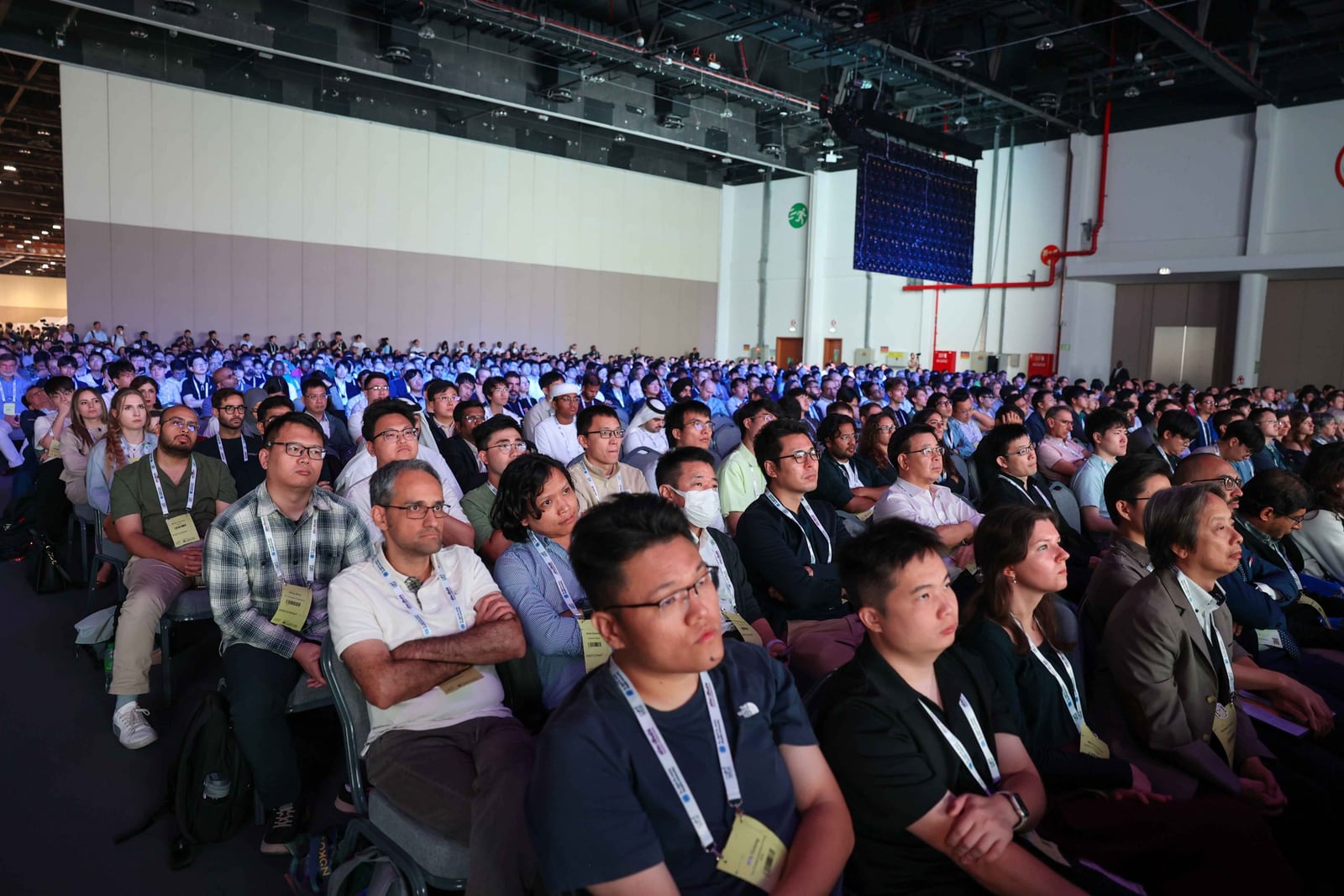
IROS bridges algorithms and hardware: a new perception method ultimately needs to support localization, movement, manipulation, and collaboration. Technical talks, workshops, robot demonstrations, and industry exhibits connect these disciplines. For Dimension Gate, the acceptance of VehAnchor brings the team’s geometric perception research into this international forum for wider discussion and potential collaboration.
Starting with an aerial image without metadata
VehAnchor uses small vehicles as geometric anchors. Oriented object detection and kernel density estimation recover ground sample distance (GSD), returning a scale estimate and confidence score that a robotic planner can use.
On DOTA v1.5, the system achieves 6.87% median GSD error across 306 images, covering approximately 67% of the evaluation images. Combined with SAM segmentation, median area measurement error is 19.7% across 100 entries. These results come from the paper’s benchmark experiments.
Giving agents a geometric tool
When vehicle anchors are insufficient or confidence is too low, the system signals the planner to use an alternative localization strategy. This perception skill gives embodied agents geometric evidence they can inspect.
About IROS 2026
The IEEE/RSJ International Conference on Intelligent Robots and Systems (IROS) is a major international conference in robotics and intelligent systems. IROS 2026 will take place in Pittsburgh, USA, from September 27 to October 1.
The venue is the David L. Lawrence Convention Center. Pittsburgh is home to robotics research institutions such as Carnegie Mellon University and an active ecosystem of autonomous vehicle and robotics companies, providing a distinctive setting for exchange between academic research and engineering practice.


Read the paper:arXiv:2603.04277 · PDF